
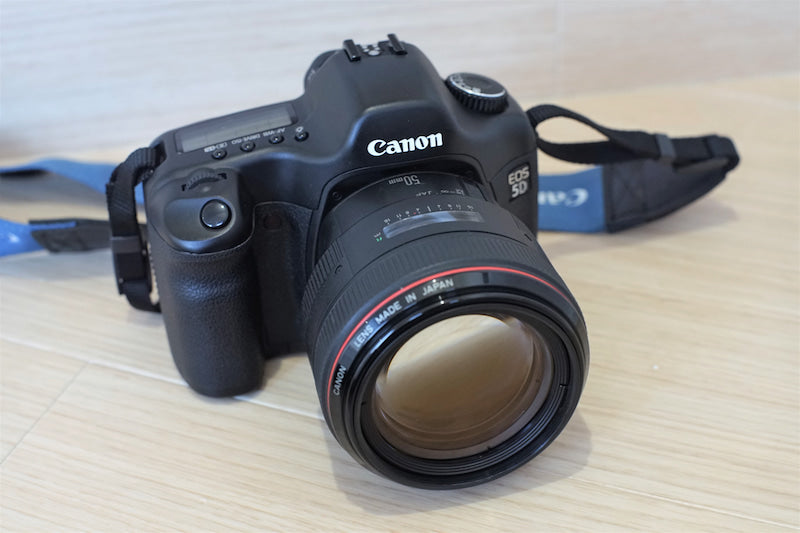
Canon EF50mm F1.0L USM
An eye that sees the night just like the human eye
I tried shooting with the legendary large-aperture lens, EF50mm F1.0L USM.

My companion was the original EOS 5D. The exterior of the lens resembles the EF85mm F1.2L USM (though the image quality is different).
This lens exists on a different dimension than evaluations such as "blazing fast autofocus" or "sharp and high-resolution."
The F1.0 aperture, said to be the brightest in the world for an SLR lens, allows for faster shutter speeds even in low light at night.

Canon EOS 5D + Canon EF50mm F1.0L USM (F1.0 SS1/30 ISO800)

Canon EOS 5D + Canon EF50mm F1.0L USM (F1.0 SS1/60 ISO800)

Canon EOS 5D + Canon EF50mm F1.0L USM (F1.0 SS1/25 ISO800)
To be honest, it has strong characteristics such as blurring in the depiction near wide open and poor resistance to backlighting.
Perhaps the purple fringing and flare appear because of its old design, which, despite being an AF lens, falls into the category of vintage lenses.
Is the F1.0 number asking too much?
Shooting near wide open creates a nostalgic impression.

Canon EOS 5D + Canon EF50mm F1.0L USM (F1.0 SS1/20 ISO800)

Canon EOS 5D + Canon EF50mm F1.0L USM (F1.0 SS1/40 ISO800)

Canon EOS 5D + Canon EF50mm F1.0L USM (F1.4 SS1/40 ISO800)

Canon EOS 5D + Canon EF50mm F1.0L USM (F1.4 SS1/40 ISO800)
Changes in depiction at each aperture
F1.0

F1.6

F2.5

F5.6

F8

F16

When stopped down, it changes its character.
Near wide open, there is significant vignetting, but from around F8, the depiction becomes ordinary and lacks individuality.
To fully appreciate the characteristics of this lens, one might shoot from wide open to about F2.8.
The soft, loose, and distinctive depiction would allow for unique images, especially in portrait photography.
At F1.0, the plane of focus is incredibly shallow. In portrait photography, if you focus on the right eye, the left eye might be out of focus, so it's crucial to confirm the focus position.


Canon EOS 5D + Canon EF50mm F1.0L USM (F1.0 SS1/125 ISO100)
Compared to modern lenses, its autofocus speed is slow, and as a standard lens, it's heavy. While it's not a practical lens for heavy everyday use, it's a highly specialized lens that allows you to enjoy a flavorful depiction.
Depending on how it's used, there should be photos that can only be taken with this lens.